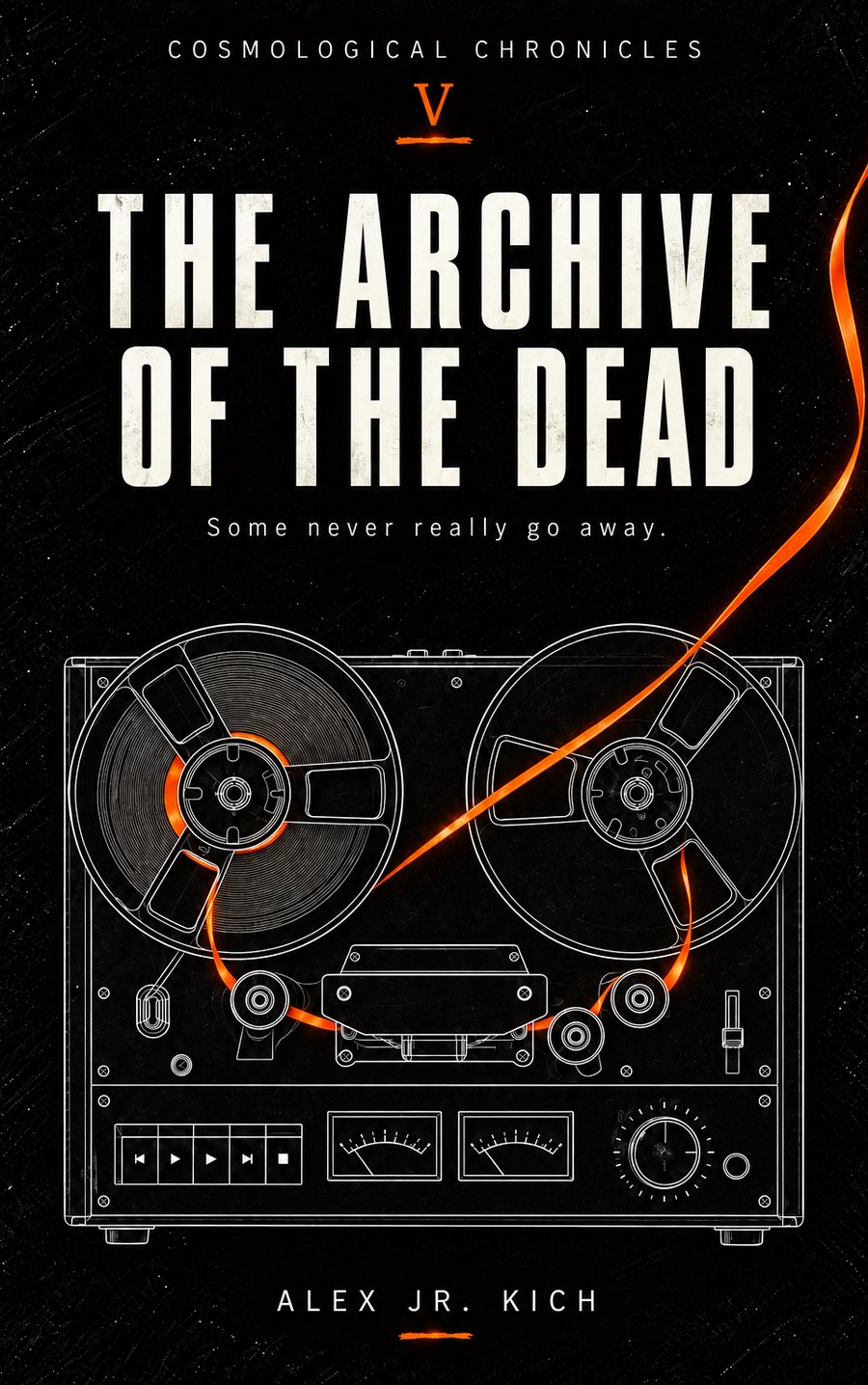
THE ARCHIVE OF THE DEAD
Alex Jr. Kich
Keeping everything about someone does not bring them back.
Near Neptune, Lívia Sato finds records of dead people.
They are not simple medical files, images or databases. There is too much detail. Voice, memory, response, traces that suggest continuity. The system seems to preserve the dead in a way that challenges the difference between archive and presence.
Then Clara appears.
The problem is that Clara has not been born yet.
The discovery breaks any simple explanation. If the Archive keeps only those who died, how can it contain someone who has not yet begun to live? If it records people, what exactly is it recording: bodies, identities, possibilities or something that crosses time?
Lívia must investigate without yielding to the most desirable answer. For anyone who has lost someone, any mechanism able to preserve a person offers an immediate temptation: to call memory survival.
The Archive of the Dead confronts its characters with that hope and demands a painful distinction. A perfect copy of someone may know everything that person knew. It may speak the same way. It may remember. But is that enough to say the person went on living?
- Series
- Cosmological Chronicles
- Volume
- V
- Original title
- O ARQUIVO DOS MORTOS
- Author
- Alex Jr. Kich
- Status
- In development
The story takes place in the outer Solar System, near Neptune, in environments where isolation and technology make any human presence more intense. Space heightens the feeling of distance from the living and closeness to the records.
The setting is cold, technical and remote, but the conflict is domestic in essence: losing someone, remembering someone, wishing for one more conversation.
Lívia Sato
Protagonist in charge of dealing with a discovery that strikes science and grief at once. She must tell evidence from desire, especially when the most seductive hypothesis is also the most emotional.
Clara
An impossible presence: she appears in the Archive before her own birth. Her existence unsettles the explanation that the system simply preserves the dead.
Beatriz
A recurring counterpart whose path connects this volume to Before We Are Born. Her presence helps link the two shores of existence: what comes before and what seems to remain after.
Caio
Reappears in another attempt of the Archive. His presence reinforces that recurring names should be read neither as simple coincidences nor as an obligatory linear continuity.
The real conflict is grief. The Archive offers exactly what mourners wish were possible: continuity. The problem is that wanting a presence to be the person who was lost does not prove that it is.
The book investigates the difference between memory and identity.
If all of a person’s memories are preserved, has the person been preserved? If a digital version reacts as they would, is that continuity enough? Is there a point at which quantity of information becomes a person?
The Archive of the Dead avoids a comfortable answer. Its interest lies in the human impulse to resist the end.
Clara’s appearance before birth shifts the problem even further. Perhaps the Archive does not keep “the dead.” Perhaps death is only the human interpretation of a much larger structure.
The central question can be put this way: are we what can be recorded about us, or is there something the record never reaches?
The novel also suggests that remembering is not the same as keeping intact. Human memory changes, loses, reorganizes. A perfect archive can be more complete than a memory and still be less alive.
Neptune, names of the dead, preserved voices, Clara, impossible archives, memory, copy and absence.
Existential science fiction with suspense, space isolation and an emotional core tied to grief.