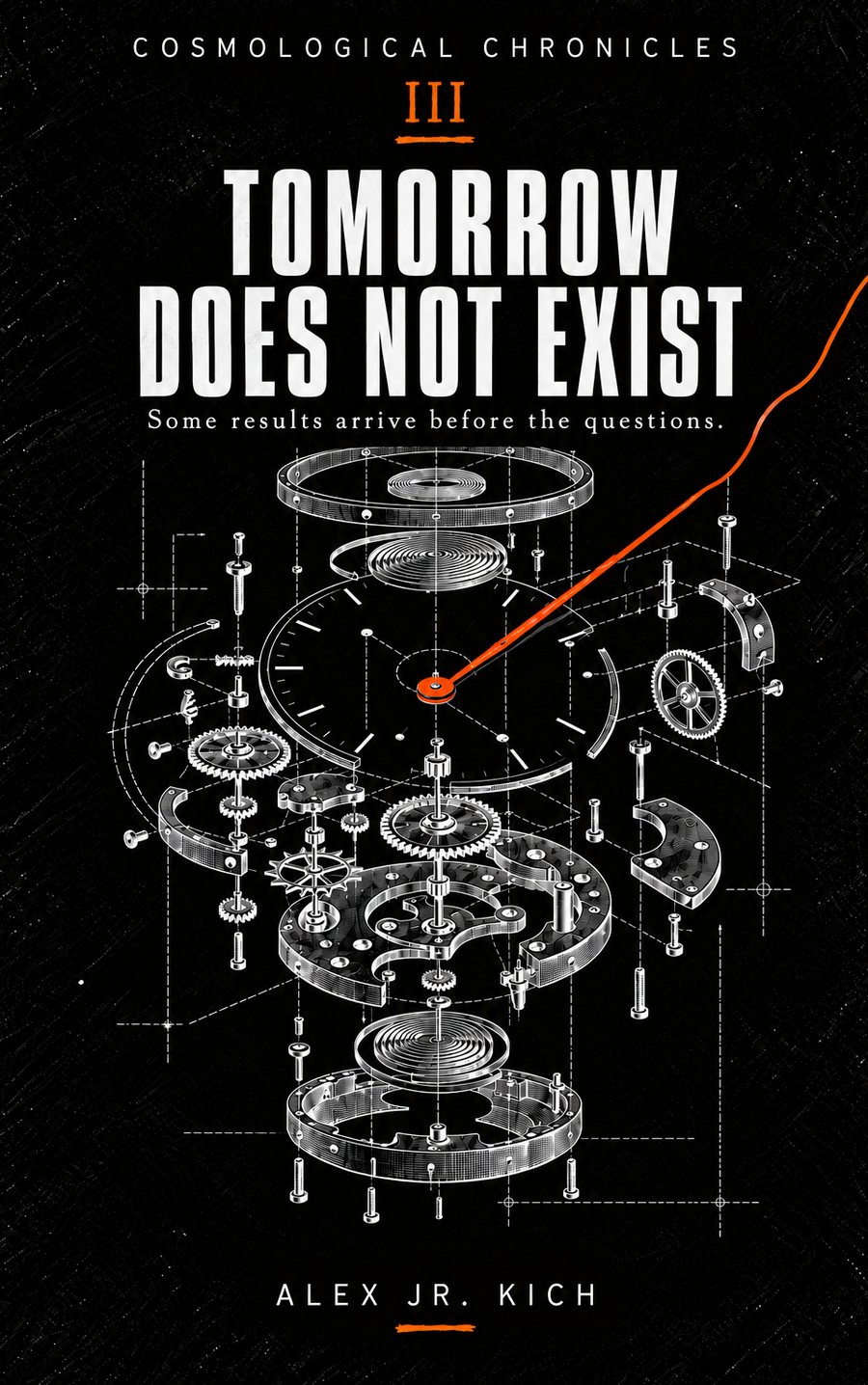
TOMORROW DOES NOT EXIST
Alex Jr. Kich
Receiving the answer before the question does not make the choice any easier.
Janus begins to produce results it should not have.
They are not predictions in the ordinary sense. The data arrives before the questions capable of generating it. For a team used to working with cause, hypothesis and test, the problem is devastating: how do you interpret an answer whose question does not yet exist?
Lia and Tomás find themselves caught between scientific possibility and human consequence. At one point, the system presents a decision that seems objective: twelve people can be saved, but four will die. The future stops being an abstraction. It has names, bodies and those responsible.
Trying to prevent the result may be precisely the mechanism that produces it. Accepting it may turn prediction into sentence. And ignoring it does not give the characters back their earlier innocence, because now they know.
Tomorrow Does Not Exist turns time travel into something more intimate and cruel. It is not a story about visiting the future. It is about receiving from it enough information to lose the safety of the present.
- Series
- Cosmological Chronicles
- Volume
- III
- Original title
- AMANHÃ NÃO EXISTE
- Author
- Alex Jr. Kich
- Status
- In development
The story is concentrated in environments of research and decision, where screens, reports and results have consequences outside the rooms where they are produced. Janus is less a spectacular machine than a rupture in the order of knowledge.
The future does not appear as a distant city or a visual backdrop. It invades the present in the form of data. This choice keeps the book close to people: the impossible arrives as information that someone must decide whether to use.
Lia
One of the collection’s most important recurring counterparts. Here she faces a problem that demands choosing without the protection of not knowing. Her relationship with responsibility sets up echoes that return later.
Tomás
Part of the core that must turn impossible results into concrete decisions. His presence helps keep the conflict on human ground, where calculation and guilt are not equivalent.
The Janus team
Represents different responses to the same problem: trusting the system, testing, resisting, using the information or denying that it can be treated as the future.
The sixteen lives caught in the dilemma
Even when they do not occupy the center of the narrative equally, they keep the problem from being reduced to mathematics. The book insists that numbers represent people.
Knowing more does not mean being able to act better. Lia and Tomás face the harshest form of this idea: having information about the future and still having no clean choice.
The novel asks what happens to freedom when the future becomes information.
If a result is known before it happens, is it destiny? If we try to avoid it and fail, were we free? If we obey the prediction, do we still choose?
Tomorrow Does Not Exist avoids resolving the paradox with a simple rule. Its interest lies in guilt. A person who knows a future consequence cannot return to the moral state of someone who knew nothing.
The dilemma of the twelve and the four makes this concrete. Mathematics can offer a balance, but it cannot absolve whoever decides. Saving more people does not automatically turn the remaining deaths into abstractions.
The title also works as a provocation. Perhaps “tomorrow” is just the name we give to what has not yet entered the present. When future information arrives before its time, that border collapses.
Janus, results without questions, clocks, lists, numbers, anticipated decisions and the moral arithmetic of twelve and four.
Science fiction of decisive tension, with a rising rhythm and dilemmas in which no alternative gives the characters back their starting position.