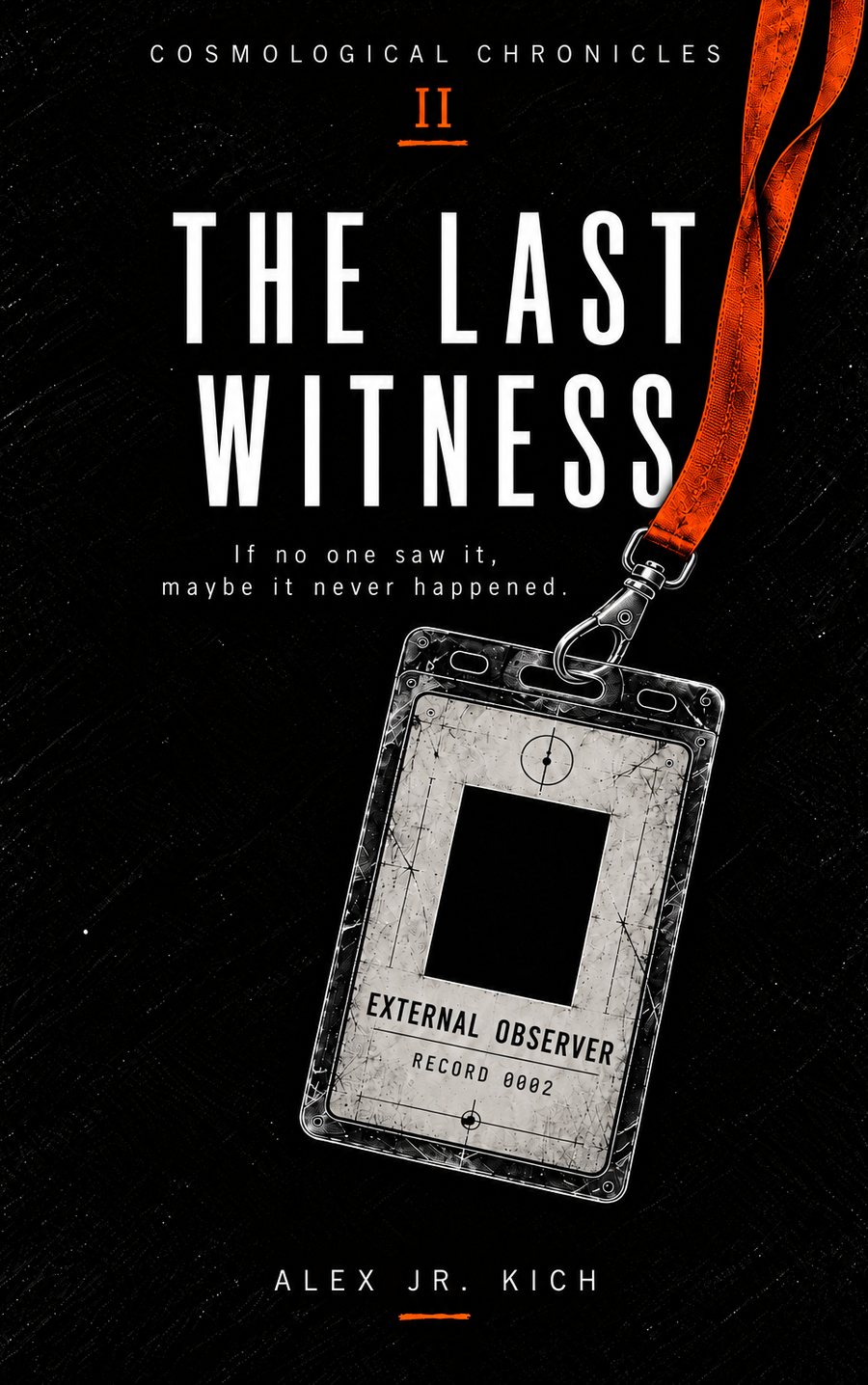
THE LAST WITNESS
Alex Jr. Kich
Some things only happen when someone is watching.
Lívia Saldanha works with images that seem to record impossible events. At first, the problem may be technical: compression, file failure, interference, editing. Then the images begin to show something else. They do not merely show the events. The presence of whoever observes seems to take part in them.
People disappear. Black rectangles appear where there should be information. Objects change position or meaning when the recording is reviewed. A cup, a blue mug, a small piece: banal details become instruments of testing because Lívia refuses to accept easy answers.
The more rigor she applies, the more unsettling the hypothesis becomes. Perhaps observing is not only receiving information. Perhaps certain things need a witness to be completed.
The problem stops being academic when the consequence of observation reaches real people. Closing one’s eyes, watching, recording, interrupting: simple choices begin to carry moral weight. Lívia must decide whether knowing is always better than not knowing.
The Last Witness is a story about images, disappearances and responsibility. It is also about the moment someone realizes that looking can be a form of acting.
- Series
- Cosmological Chronicles
- Volume
- II
- Original title
- A ÚLTIMA TESTEMUNHA
- Author
- Alex Jr. Kich
- Status
- In development
The setting is contemporary and built around images, archives, screens, analysis rooms and ordinary places recorded by cameras. Physical space matters, but the novel’s true territory is the passage between event and record.
Earth is seen again and again through technical means. This creates a specific feeling: the familiar begins to look remote once turned into a frame, a file or a sequence. Horror is born when that distance stops protecting the observer.
Lívia Saldanha
Protagonist and the rational axis of the story. Her strength lies in refusing easy conclusions. She tests hypotheses, looks for contradictions and accepts changing her mind when evidence demands it. The price of that honesty is discovering that the very act of observing may have consequences.
Bruno
Takes part in the experiments and checks that turn strange phenomena into testable problems. His interaction with objects and images helps make concrete a rule that seemed impossible.
Davi
His presence links the book’s drama to absences that cross other stories. What happens to him widens the human dimension of the phenomenon.
The erased people
They are not merely a set of victims. Each absence forces the question of what remains of a person when the record that should prove them begins to fail.
The central conflict is the weight of bearing witness. There are moments when not looking seems cowardly; at others, looking may cause harm. Lívia must deal with an impossible responsibility: how to act when knowing an event may help produce it?
The Last Witness explores the idea that observation is not necessarily neutral.
In ordinary life we believe that looking at a photograph or watching a recording does not change what already happened. The novel breaks that certainty. From there a wider question is born: is there a reality completely separate from whoever perceives it?
The book does not try to turn physics into magic. Its interest is moral. If the observer takes part in the event, the observer also takes part in the responsibility.
This changes the meaning of testimony. To bear witness is usually understood as a duty: to see, to remember, to tell. Here, however, the witness may be precisely what the phenomenon needs.
Lívia’s dilemma reaches its peak when closing her eyes stops meaning ignorance and becomes an ethical choice. Not all knowledge is innocent. Not every image is passive.
Video frames, black rectangles, a Lego piece, a cup, a blue mug, cameras, incomplete files and the act of closing one’s eyes.
Scientific and psychological suspense, with simple experiments, growing consequences and a threat that manifests through images.