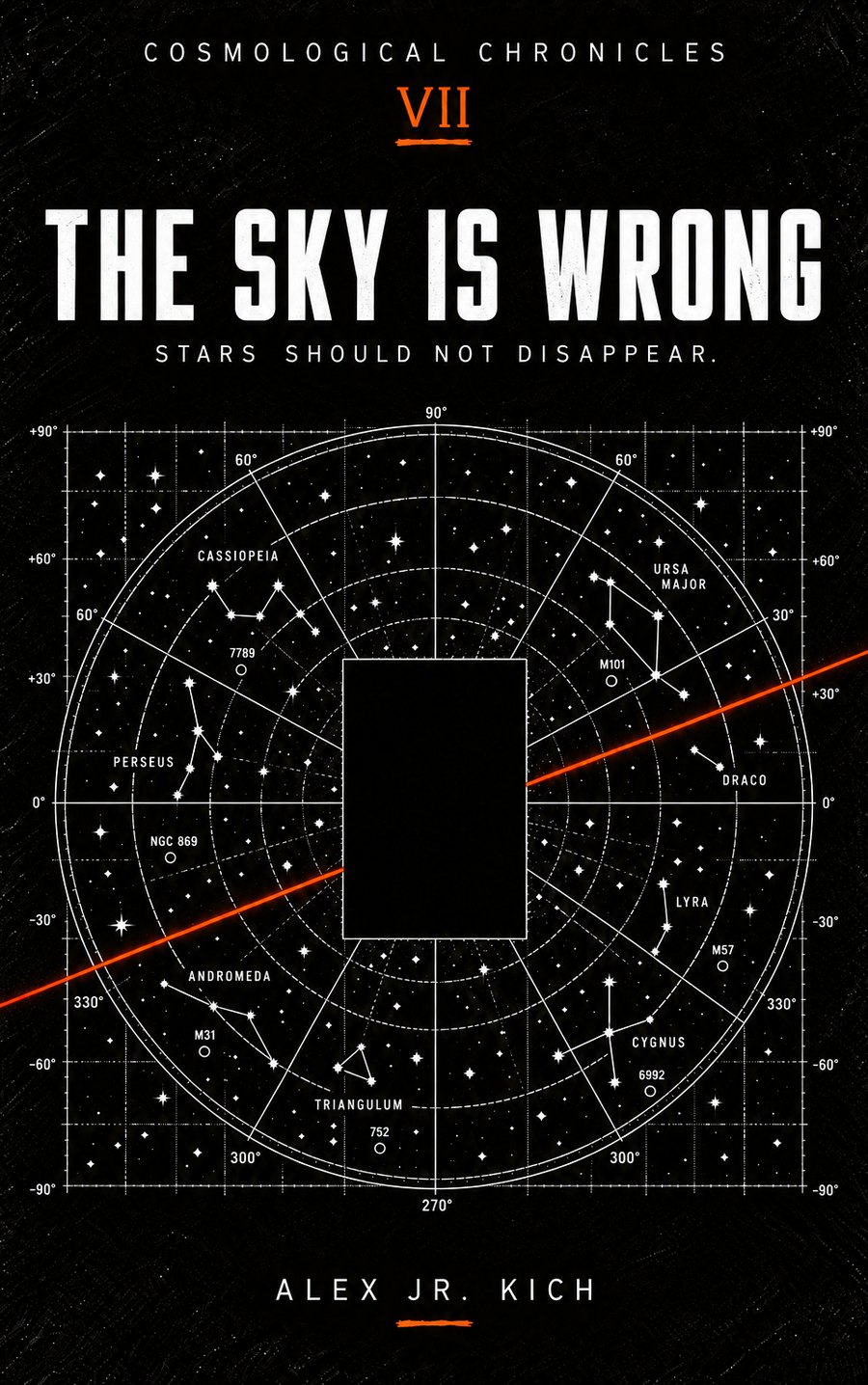
THE SKY IS WRONG
Alex Jr. Kich
First the stars disappear. Then the people. The worst part is when no one notices they are missing.
Helena Vilar notices that the sky has changed.
It is not a shooting star, a forecasting error or a bad night of observation. Certain points have simply stopped being where they should be. The problem would be extraordinary on its own, but it soon gains a more disturbing layer: records, memories and explanations seem to rearrange themselves around the absences.
On another front of the story, Ilse Moura begins to experience a much closer disappearance. Familiar things stop fitting. There are three plates on the table, but the logic of the house insists there should perhaps be only two. A domestic absence begins to take on the same impossible shape as the absences in the sky.
The phenomenon does not seem to destroy. It erases relationships.
Helena tries to prove that something vanished while every new record makes it harder to prove that it was ever there. Ilse faces an even crueler version of the same problem: remembering someone the world begins to treat as if they had never existed.
The Sky Is Wrong follows the moment when absence stops being a lack of information and becomes a force able to rewrite the context around what disappeared.
- Series
- Cosmological Chronicles
- Volume
- VII
- Original title
- O CÉU ESTÁ ERRADO
- Author
- Alex Jr. Kich
- Status
- In development
The novel works on two scales in parallel. One looks at the sky and at astronomical records. The other stays inside the home, among objects, places at the table and family habits.
This montage is essential. The disappearance of a star and the disappearance of a person are incomparable in size, but emotionally the second is far greater. The cosmos only gains weight when it meets a kitchen.
Helena Vilar
Notices inconsistencies in the sky and must prove an absence in a system that begins to correct itself against the very proof. A character of persistence and method.
Ilse Moura
Mother of Rafael and Davi. Her connection to the disappearances turns the phenomenon into a family experience. She begins to occupy the position of the one who remembers when others stop remembering.
Rafael
The absence begun in SIGNAL/NOISE gains new weight when the erasure stops affecting only physical presence and starts to reach memory and context.
Davi
His absence connects The Last Witness to this stage of the phenomenon. For Ilse, the missing are not cases. They are sons.
The conflict is the isolation of the one who remembers. Losing someone is already painful; being the only person who believes someone existed also erodes trust in one’s own memory.
The Sky Is Wrong asks whether destroying is really the most complete way of erasing something.
A star may disappear but leave records. A person may die but remain in photographs and memories. The phenomenon in this book goes further: it removes the relationships that sustained the existence of what vanished.
The central question is: if no one can remember something, was it ever real?
The novel treats collective memory as part of human reality. We exist not only inside ourselves, but in the memory of other people, in documents, habits, places, objects and expectations.
That is why the three plates on the table matter as much as the sky. The third plate is a small rebellion against the new version of the world.
The book also prepares an important distinction: forgetting is not the same as losing. Something may remain outside the dominant memory.
Absent stars, sky maps, three plates, photographs, empty places and small domestic incoherences.
Cosmic and domestic suspense in parallel, with a growing sense that reality is correcting its own absences.