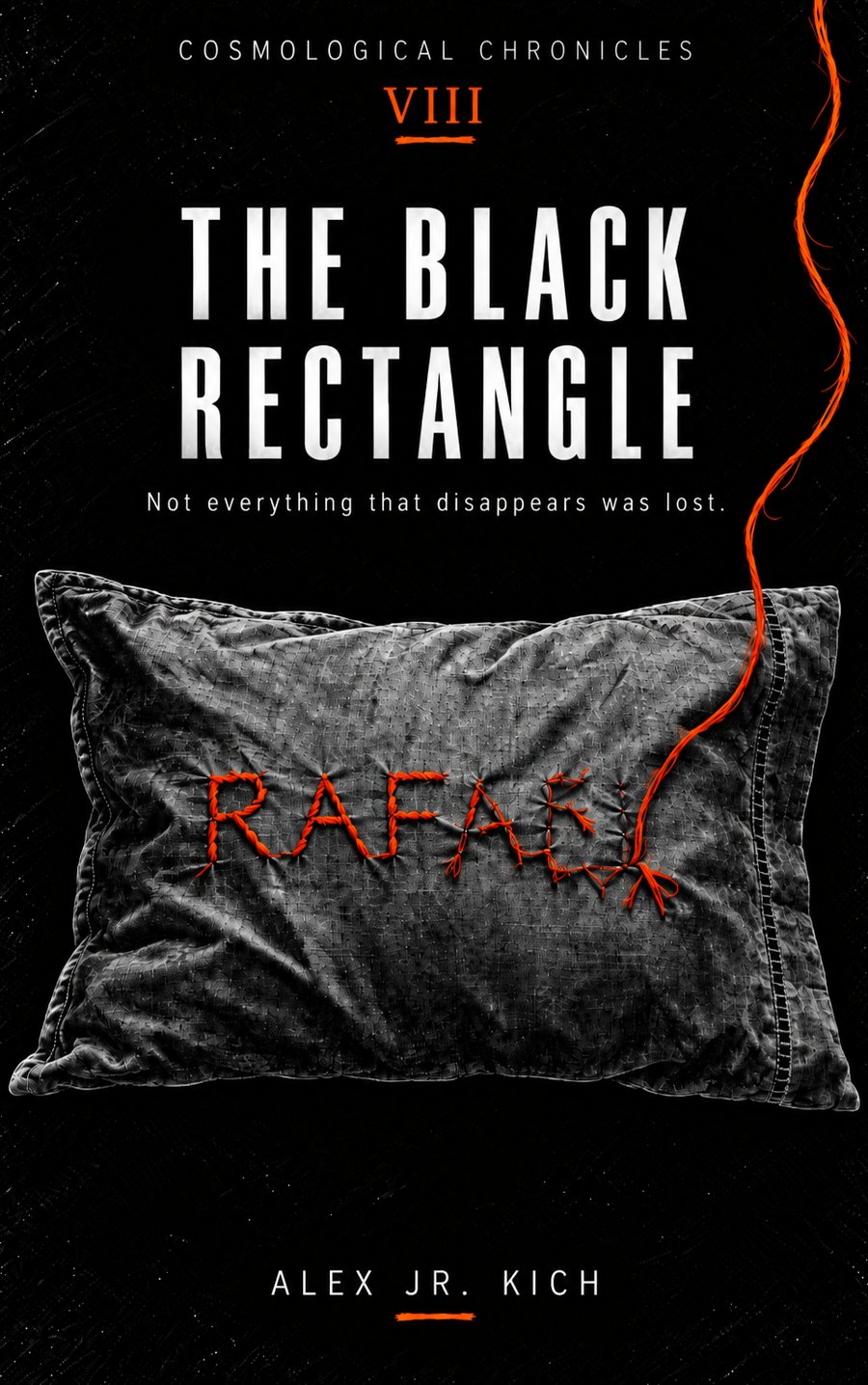
THE BLACK RECTANGLE
Alex Jr. Kich
Not everything that vanishes was lost.
Ilse Moura remembers two sons the world does not recognize.
Rafael disappeared by a farm gate. Davi disappeared afterward. Now the phenomenon that could once be treated as tragedy, coincidence or impossibility changes nature. Photographs show black areas. Objects lose their context. Records no longer prove what Ilse knows she lived.
The black rectangles grow.
They do not seem to be simple image failures. Where they appear, relationships begin to disappear. People forget names. Family stories rearrange themselves. Reality finds ways of explaining the empty space.
Ilse is the exception.
Forgetting does not reach her in the same way. That resistance makes her the last guardian of two lives the world is abandoning. The search is no longer only to find out where Rafael and Davi are. It is to prevent the very idea that they existed from being erased.
The Black Rectangle brings into a house the terror that other volumes observed on screens and in the sky. The extraordinary no longer needs to be sought. It is in the family photograph, in the bedroom, in the pillowcase, in the object someone insists on keeping even when no one understands why.
- Series
- Cosmological Chronicles
- Volume
- VIII
- Original title
- O RETÂNGULO NEGRO
- Author
- Alex Jr. Kich
- Status
- In development
This is one of the most domestic books in the collection. Ilse’s house, her objects, photographs, bedrooms and memories form the main battlefield.
The effect is deliberate: after cosmic phenomena, horror fits in a drawer. An embroidered pillowcase, a photograph and a plate can carry more tension than any image from space because they hold emotional history.
Ilse Moura
Protagonist and emotional center. Mother of Rafael and Davi, she is the person in whom forgetting does not work as it should. Her memory stops being mere remembrance and becomes resistance.
Rafael
A son whose absence goes back to SIGNAL/NOISE. In the book he exists mainly through the space he should occupy and Ilse’s effort to keep that space from being normalized.
Davi
The second lost son. His link to The Last Witness makes the erasure a pattern that Ilse perceives before any complete explanation.
The people around Ilse
They are fundamental because they show the mechanism of the phenomenon. They are not pretending to forget; the world truly seems to offer them a version in which Rafael and Davi never had a place.
The book is about a mother fighting the normalization of absence. The threat is not only losing her sons, but being convinced by the whole world that there were never sons to lose.
The Black Rectangle turns memory into an act of resistance.
Identity does not live only inside the individual. It is distributed among other people, objects, photographs, stories, documents and habits. When those links disappear, a person can be erased without their body having to be destroyed before our eyes.
The central question is brutal: if only one person remembers you, do you still exist?
Ilse offers a practical answer. As long as she remembers, the erasure is not complete.
The book also explores the difference between truth and consensus. If all the evidence says Rafael never existed, but Ilse holds a true memory of him, does reality belong to the majority or to the event?
“Not everything that vanishes was lost” sums up the philosophy of the volume. There are things outside the record that remain real. There are bonds that survive even when the world stops confirming them.
Black rectangles, photographs, a pillowcase embroidered with the name Rafael, thread, ownerless objects, bedrooms, forgotten names and maternal memory.
Existential and domestic horror with more movement and action, keeping the mystery tied to concrete objects and relationships.