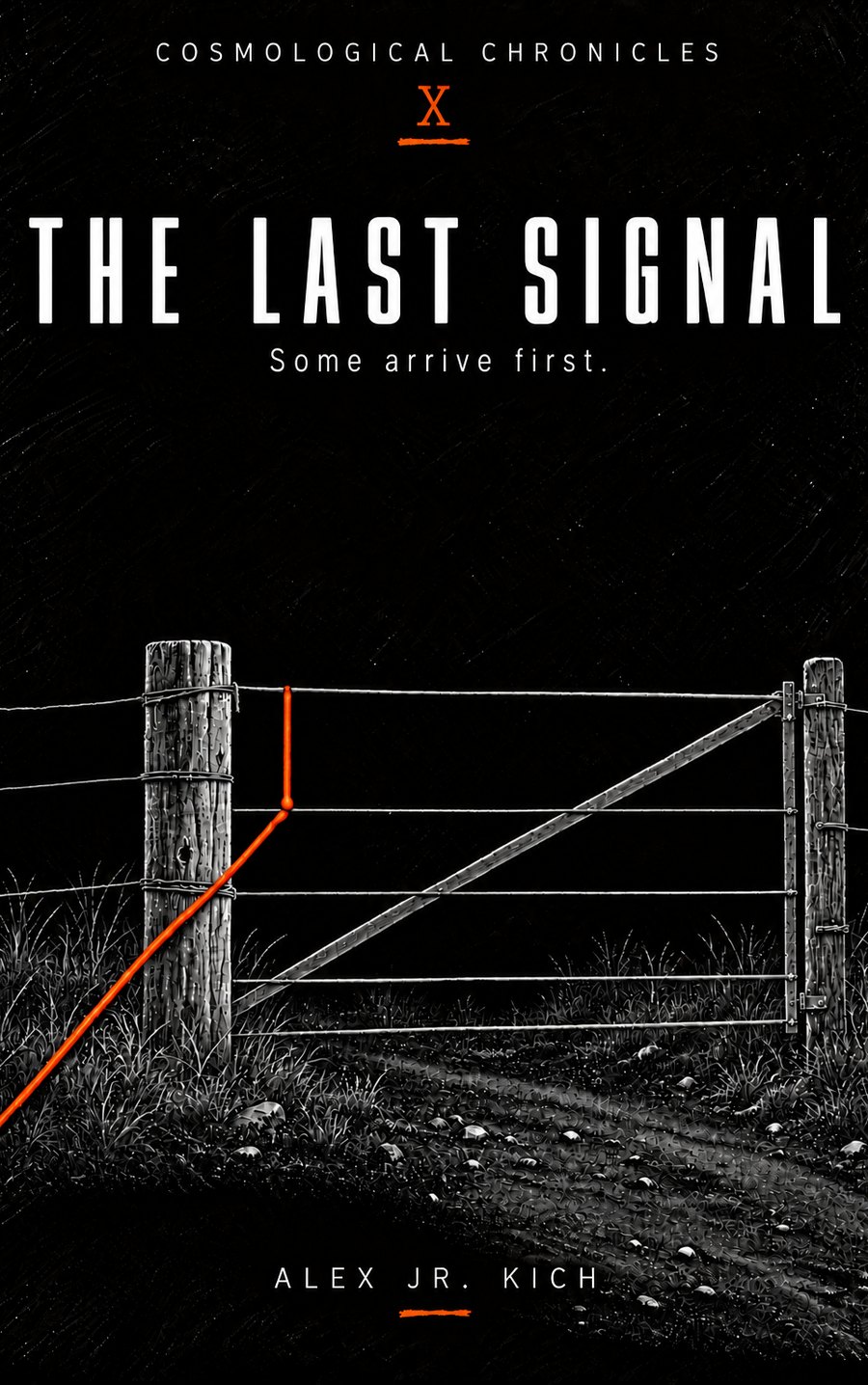
THE LAST SIGNAL
Alex Jr. Kich
If one of us arrives first, wait for the other.
Lia Navarro is entrusted with a responsibility no single person should have to bear.
After stories about origin, observation, time, silence, death, birth, forgetting and language, different traces begin to converge. Not as pieces of a puzzle that will finally explain everything, but as records of attempts.
There are forty-four. Three are missing. Forty-one remain.
The Council of Helenas puts side by side versions that should not share a room under any ordinary logic of identity. Clara, Tomás, Lia and other presences return under new relationships. The Archive stops looking like a distant object and comes closer to a decision.
Earth must answer.
But the final answer is not conquest, surrender or absolute revelation. It is a choice about time, encounter and reciprocity.
The message that has crossed the collection takes its full form: “If one of us arrives first, wait for the other.”
And then the story returns to August 15, 1977.
To the point where everything seemed to have begun.
- Series
- Cosmological Chronicles
- Volume
- X
- Original title
- O ÚLTIMO SINAL
- Author
- Alex Jr. Kich
- Status
- In development
The last volume has the largest scale in the collection, but it must keep the Principle of Human Scale. Even when decisions involve Earth, versions and the Archive, the narrative stays anchored in concrete people, rooms, objects, messages and choices.
The structure closes a temporal ring by touching August 15, 1977, the date of the Wow! signal, once more. This connects the end of the Cosmological Chronicles to the work of origin without making SIGNAL/NOISE required reading.
Lia Navarro
At the center of the volume, she is entrusted with a responsibility that goes far beyond possession. Her path carries the question of individual responsibility to a collective scale.
The Helenas
The council makes explicit the logic of recurring counterparts. Helena is not just a repeated name: they are different attempts of the Archive, placed in relation without erasing their individual lives.
Tomás
Returns at a point where earlier decisions about time and consequence gain a new reading.
Clara
Her presence links the impossible future of The Archive of the Dead to the closing of the collection.
Earth
Without simplistic personification, it becomes part of the decision. The ending depends on humanity answering not as owner of the process, but as a participant.
The final conflict is not defeating the Archive. It is deciding what kind of relationship can exist with something that records more than any person can understand. The ending must preserve choice, waiting, and human connection.
The Last Signal gathers the earlier questions without reducing them to a single answer.
The collection began by asking what a signal is. Then it asked who creates, who observes, when something happens, how the universe answers, what remains after death, what exists before birth, what happens when we forget and what is lost when a word is missing.
The last book asks what we do with all of this.
The philosophical answer is not dominion. It is waiting.
Waiting usually looks like passivity, but here it becomes a form of recognition. It means accepting that two intelligences, two people or two counterparts may not arrive at the same point at the same time.
“If one of us arrives first, wait for the other” turns communication into ethics. It is not enough to send. It is not enough to receive. One must leave room for the other to arrive.
This idea also redefines the Archive. Something able to record everything may still not understand bond. A record can preserve states; waiting acknowledges distance.
The collection’s secret question then becomes: why did something able to record everything still need us?
Two threads that meet, a farm gate, 44 minus 3 equals 41, the Council of Helenas, stewardship, August 15, 1977, signal and waiting.
Emotional and cosmic convergence. The book widens its scale without abandoning concrete people and avoids turning the ending into a cosmology lecture.