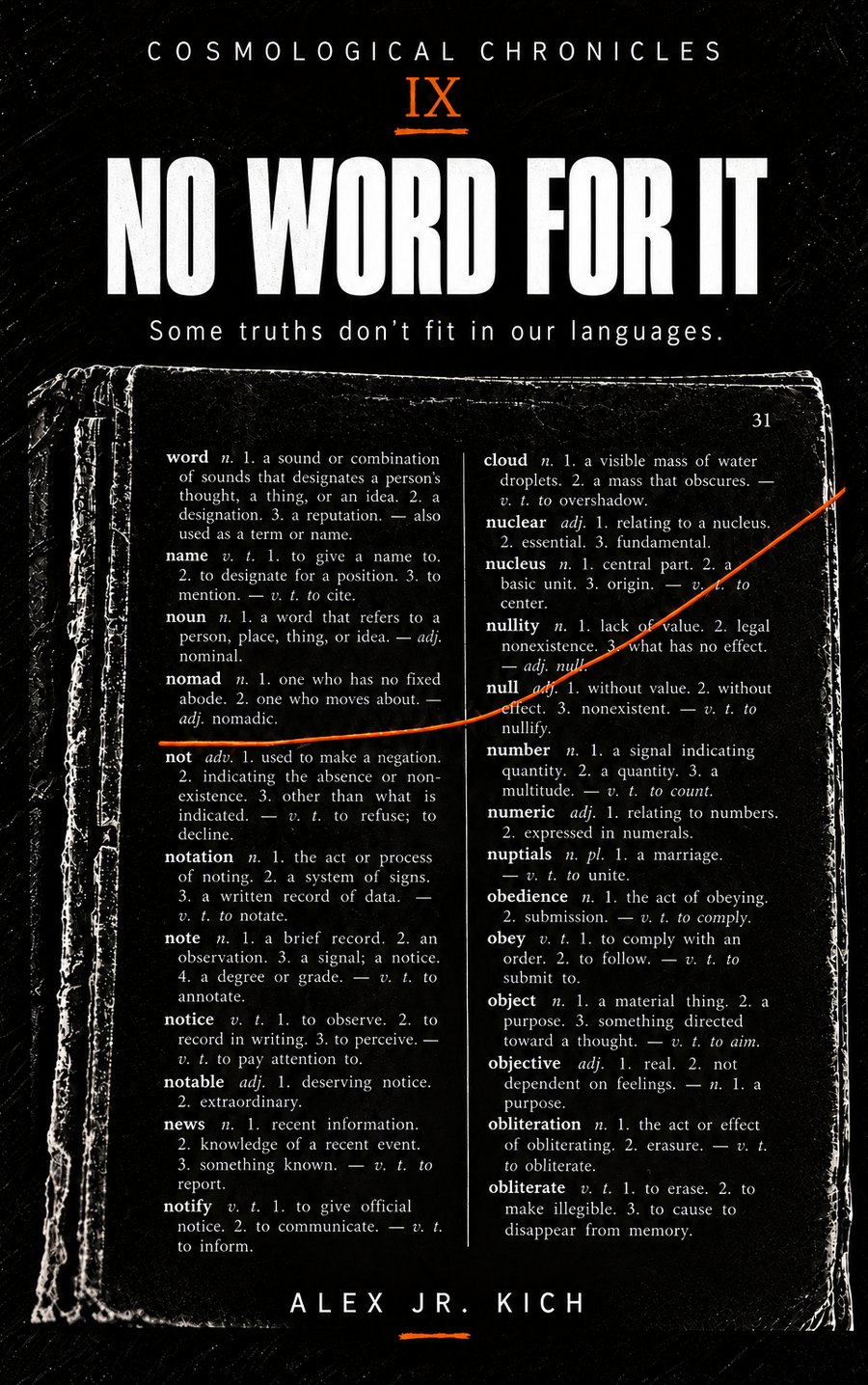
NO WORD FOR IT
Alex Jr. Kich
Some things disappear when they stop having a name.
Nara Guedes finds a word that no longer exists.
The last person able to pronounce it belongs to a language on the verge of disappearing. For linguistics this would already be an urgency: when the last speaker dies, what is lost is not just a set of sounds but a specific way of organizing the world.
Then the word produces an impossible effect.
For 1.7 seconds, something called Valandor opens.
No one knows whether the word names the place, creates the access, describes a condition or merely coincides with the phenomenon. Nara must work on dangerous ground because any attempt at translation may destroy exactly what it means to understand.
The problem grows when it becomes clear that certain realities may depend on distinctions that other languages do not have. A lost word may carry a perceptual difference that disappears with it.
No Word for It turns language into a physical and philosophical frontier. The unknown is not only beyond instruments. It may be beyond vocabulary.
- Series
- Cosmological Chronicles
- Volume
- IX
- Original title
- NÃO TEM A PALAVRA
- Author
- Alex Jr. Kich
- Status
- In development
The setting is born from the meeting of linguistic research, oral memory and records. The book must preserve the concrete presence of the last speaker: voice, breath, hesitation, context and relationship with her own language.
Valandor appears in contrast with that intimacy. For just 1.7 seconds, a small word touches a much larger structure.
Nara Guedes
Protagonist. Her task demands rigor and humility because translating is not swapping one word for another. She must recognize when a language holds a distinction her own cannot reproduce.
The last speaker
She must not work as a mere key to a riddle. She is a person carrying an entire language in an extreme situation. Her story, memory and will matter as much as the word others wish to record.
Valandor
More than a place, it works as a conceptual opening. The brief access shows that language and reality have a relationship the characters do not yet understand.
At the center of the book is cultural loss. A language can disappear without an explosion, without ruins and without a world headline. When the last person stops speaking, an entire way of distinguishing the real may disappear with them.
No Word for It builds on a simple idea: naming is not merely putting labels on things.
Languages divide colors, tenses, relationships and experiences in different ways. Some distinctions exist clearly in one language and require whole sentences in another.
The novel widens this: what if there are aspects of reality that can only be perceived or accessed when a given linguistic distinction exists?
The central question is: does something cease to exist when we lose the word to recognize it?
The book need not answer literally that words create the world. The proposal is more interesting if it stays ambiguous. Perhaps the word is a key. Perhaps it is an instruction. Perhaps it is only the last human instrument able to point correctly at something that was always there.
The loss of a language, then, stops being merely a loss of vocabulary. It becomes a loss of access.
A dictionary entry without a word, a blank line, the last speaker, a voice recording, 1.7 seconds, Valandor, translation and silence.
Linguistic and existential science fiction, with tension built from loss, translation and an extremely brief access to the unknown.